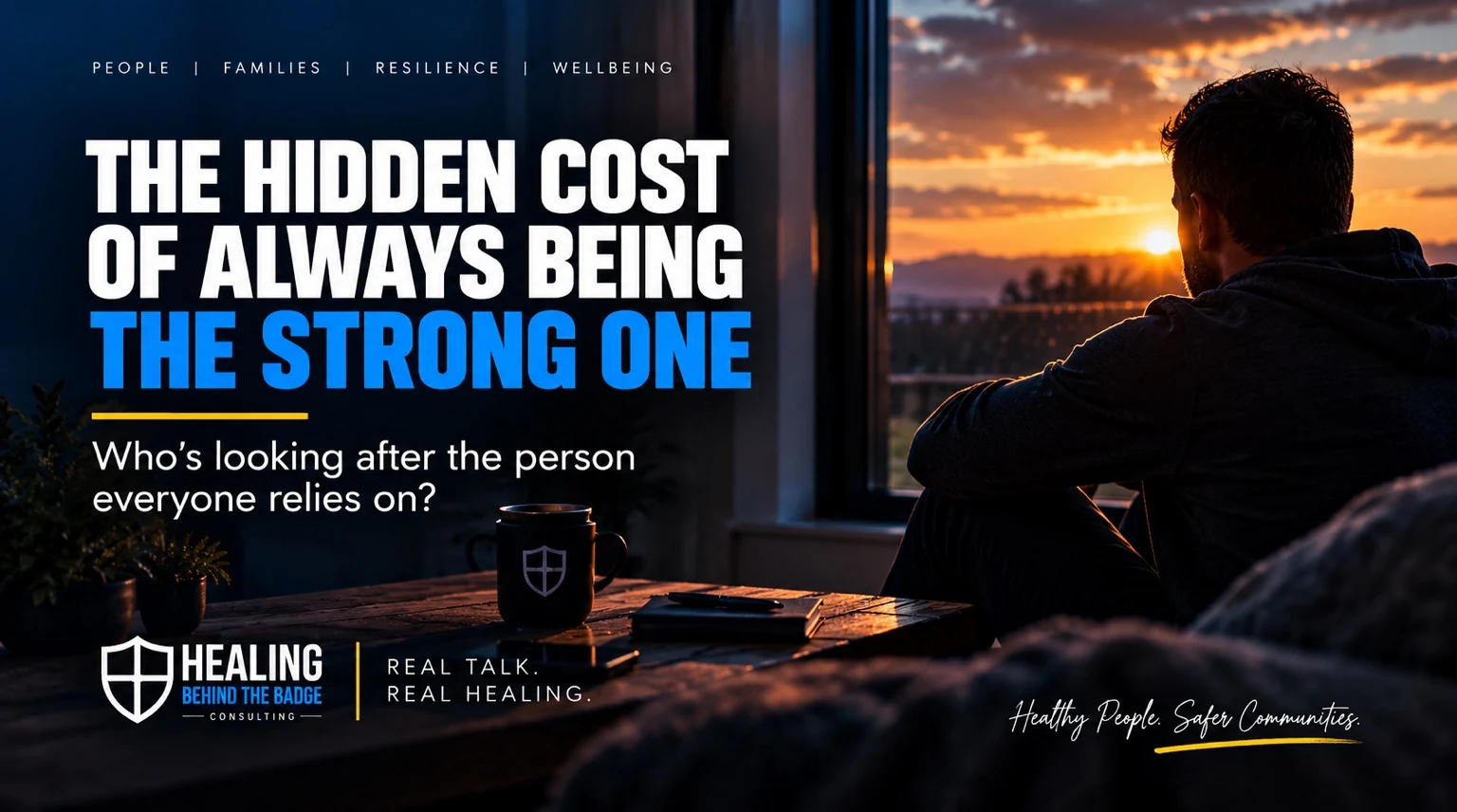
There’s a strange thing that happens when you’ve spent most of your life being the person everyone relies on.
People stop asking whether you’re okay.
Not because they don’t care.
But because you’ve become so good at appearing strong that they assume you always are.
And somewhere along the way, you start believing it yourself.
You’re the dependable one.
The problem solver.
The person who keeps their emotions in check.
The one who steps up when things get difficult.
And while there’s nothing wrong with being strong, there can be a hidden cost when you start believing that strength means never showing anyone you’re struggling.
I know, because for a long time, that was me.
When being strong becomes your identity
For much of my life, I believed being strong meant getting on with things.
You dealt with whatever was in front of you.
You didn’t complain.
You didn’t burden other people with your problems.
And if something was bothering you, you pushed it aside and kept moving.
Working in frontline policing for more than two decades reinforced some of those beliefs.
You learn to make decisions under pressure.
You learn to manage difficult situations.
You learn to put your own emotions aside because someone else needs you to be calm, focused and capable.
And in the right circumstances, those skills are incredibly valuable.
But there’s a difference between managing your emotions when the situation demands it and never allowing yourself to feel them afterwards.
That’s something I didn’t understand for a long time.
I became very good at compartmentalising.
Putting things in boxes.
Closing the lid.
Getting on with the next job.
The problem was, I rarely went back and opened those boxes.
The pressure nobody talks about
When people see you as the strong one, there’s an expectation that comes with it.
Sometimes it’s placed on you by others.
Sometimes it’s entirely self-imposed.
You feel responsible for holding everything together.
At work.
At home.
For your family.
For your colleagues.
For everyone who depends on you.
And the thought of admitting you’re struggling can feel almost impossible.
Because if you’re the person who always has the answers, what happens when you don’t?
If you’re the one everyone turns to, who do you turn to?
And if you’ve spent years telling yourself that you’re okay, how do you suddenly admit that you’re not?
Those questions can be confronting.
So instead, you keep going.
You tell yourself you’re just tired.
That things will settle down.
That you just need a holiday, a better night’s sleep or a quieter week.
And sometimes those things genuinely help.
But sometimes there’s something deeper happening.
Something that can’t be fixed by simply pushing harder.
I thought I was coping
Looking back at my own experience, I can see things now that I couldn’t recognise at the time.
I was withdrawing.
My sleep was suffering.
I was becoming disconnected from the people and things that mattered most.
I was physically present but often mentally somewhere else.
And rather than recognising those changes as warning signs, I kept trying to function the way I always had.
Because that’s what I knew.
Keep going.
Get through the day.
Don’t let anyone down.
But here’s what I’ve learned.
You can be incredibly good at functioning while becoming increasingly disconnected from yourself.
Eventually, I reached a point where I couldn’t keep pretending everything was okay.
I needed help.
And accepting that was one of the hardest things I’ve ever had to do.
Not because asking for help was wrong.
But because it challenged everything I’d come to believe about who I was supposed to be.
Vulnerability isn’t the opposite of strength
For years, I saw vulnerability as something to avoid.
I associated it with weakness.
With losing control.
With letting people see a side of me that I thought I needed to keep hidden.
My experience changed that.
Through treatment, reflection and rebuilding my life, I began to understand that vulnerability wasn’t something I needed to be ashamed of.
It was something I needed to learn.
Being able to say, “I’m struggling.”
Being able to admit, “I don’t have all the answers.”
Being able to sit with uncomfortable emotions instead of immediately trying to push them away.
Those things took more courage than I expected.
And they changed the way I connect with people.
Today, I often say that vulnerability is my superpower.
Not because I find it easy.
Not because I share everything with everyone.
But because I’ve learned that being open about my experiences can create space for someone else to be open about theirs.
And sometimes, that’s where real healing begins.
What about the people waiting at home?
There’s another part of this conversation that I think we overlook.
The people who love us.
Our partners.
Our children.
Our families.
When you’re always trying to be the strong one, you can unintentionally shut out the very people who want to support you.
You tell yourself you’re protecting them.
That they don’t need to know what you’re carrying.
That you’ll deal with it yourself.
But the pressure doesn’t always stay hidden.
It can come out as irritability.
Silence.
Withdrawal.
A lack of patience.
Or simply not being emotionally available.
And the people closest to us can end up experiencing the consequences without understanding what’s happening.
I had to learn that being a good husband and father didn’t mean pretending I was unaffected by everything.
It meant being present.
Being honest.
Being willing to have difficult conversations.
And recognising that the people I loved didn’t need me to be invincible.
They needed me to be there.
You don’t have to earn the right to struggle
One of the things I hear in conversations about mental health is people comparing their experiences.
“Other people have had it worse.”
“I shouldn’t be complaining.”
“I’ve got a good life. What have I got to be stressed about?”
I understand that thinking.
I’ve been there.
But someone else’s suffering doesn’t invalidate your own.
You don’t need to experience the worst possible trauma to deserve support.
You don’t need to reach crisis point before you can acknowledge that something has changed.
And you certainly don’t need to prove how much you can endure before you’re allowed to ask for help.
You can be grateful for your life and still be struggling.
Both can be true.
Strength can look different
These days, my understanding of strength is very different.
Sometimes strength is getting through a difficult day.
Sometimes it’s setting a boundary.
Sometimes it’s telling someone you need a break.
Sometimes it’s having an honest conversation with your partner.
Sometimes it’s making an appointment with a health professional.
And sometimes it’s simply acknowledging that you’re not doing as well as you’d like people to believe.
None of those things makes you less capable.
Less dependable.
Less of a leader.
Less of a parent.
Or less of a person.
They make you human.
And being human was something I had to learn to give myself permission to be.
A message to the strong ones
If you’re the person everyone relies on, I want you to consider something.
When was the last time you genuinely checked in with yourself?
Not whether you’re getting through the work.
Not whether the bills are paid.
Not whether everyone else is okay.
But whether you’re actually okay.
Are you sleeping?
Are you enjoying the things you used to love?
Are you connecting with the people who matter?
Are you giving yourself permission to slow down?
And perhaps most importantly, is there someone in your life who knows how you’re really going?
Because you deserve support too.
You deserve to be heard.
You deserve to have difficult days without feeling like you’ve failed.
And you deserve relationships where you don’t always have to be the person holding everything together.
I’ve learned that the strongest version of myself isn’t the one who hides everything.
It’s the one who’s willing to recognise when something isn’t right and do something about it.
I didn’t bounce back. I rebuilt.
And part of that rebuilding was learning that I didn’t have to carry everything on my own.
So here’s my question.
If you’re always the strong one for everyone else, who’s looking after you?
⸻
Anthony Pymm
Principal Consultant | Healing Behind the Badge Consulting
Real Talk. Real Healing.