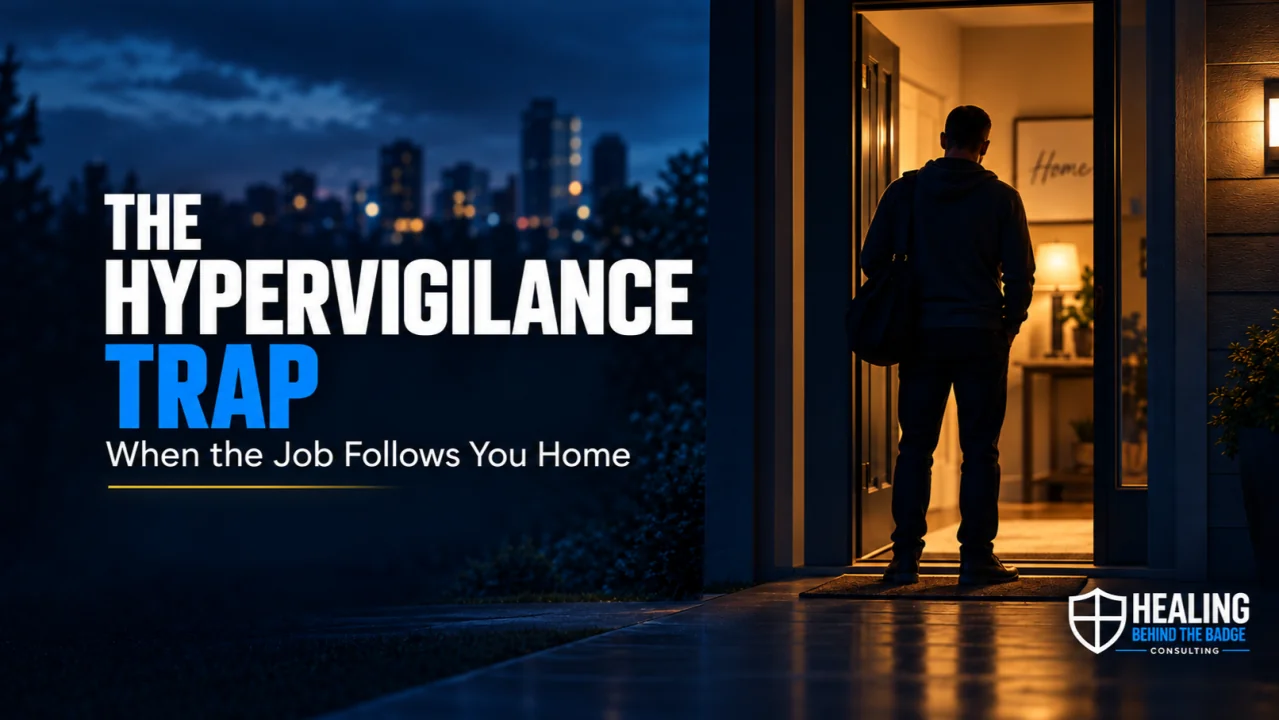
For years, I thought being constantly alert was simply part of being good at the job.
After decades in frontline policing, scanning people, reading environments and preparing for what might happen next became automatic. That awareness served a purpose at work.
The problem was that my mind and body did not always understand when the shift had finished.
I could walk through the front door, but part of me was still working.
Still scanning.
Still replaying conversations.
Still preparing for something to go wrong.
Physically, I was home. Emotionally, I was somewhere else.
What is hypervigilance?
Hypervigilance is a heightened state of alertness. It can develop when someone has spent extended periods working in unpredictable, dangerous or high-pressure environments.
The nervous system learns that staying ready helps keep you safe.
That response can be valuable during an emergency, critical incident or operational situation. But when the danger has passed and the body remains activated, it begins to affect life away from work.
It may look like:
• Constantly checking your surroundings • Sitting where you can see the exits • Being easily startled by unexpected sounds • Replaying incidents and conversations • Struggling to relax or fall asleep • Feeling uncomfortable in crowded places • Becoming impatient or irritable over small things • Needing control because uncertainty feels unsafe • Feeling emotionally distant from the people you love
Many first responders do not recognise these changes immediately. The behaviour can feel normal because it developed gradually—and because everyone around them may be experiencing something similar.
When the job follows you home
The people at home often notice the change first.
They see that you are physically present but emotionally unavailable. They notice the short fuse, the silence, the restless sleep or the need to withdraw.
They may not understand why you seem distant. You may not understand it either.
This can create a painful misunderstanding.
The first responder may feel:
“I’ve given everything today. I just need space.”
Their partner or family may experience:
“You came home, but you’re not really here.”
Neither side is necessarily wrong.
One person is trying to regulate after sustained pressure. The other is trying to reconnect with someone they love.
The problem is not always a lack of love or commitment. Sometimes it is the absence of a deliberate transition between work and home.
Throw it in the bin
One practical tool that has helped me is something I call “Throw It in the Bin.”
It creates a clear boundary between processing the day and carrying it indefinitely.
Before walking through the front door, give yourself ten minutes.
For those ten minutes, name what is still sitting with you.
What happened today?
What are you replaying?
What emotion are you carrying?
Is there something that requires action—or is your nervous system simply refusing to stand down?
Sort what you are carrying into three categories:
- Something I need to act on Write down the next practical step. You do not need to solve it tonight.
- Something I need to talk about Identify a safe person and decide when you will have that conversation.
- Something I cannot change tonight Acknowledge it, imagine placing it in a bin outside the front door, and give yourself permission to leave it there.
This is not about pretending that difficult experiences did not happen. It is about containing them so they do not consume every part of your life.
After ten minutes, the processing time ends.
Take a slow breath.
Drop your shoulders.
Unclench your jaw.
Notice where you are.
Then turn towards home.
The people inside do not need a perfect version of you. They need a version of you who is willing to arrive.
A transition, not an instant transformation
You may not be able to switch off immediately. After years of conditioning, the nervous system rarely changes because we simply tell it to relax.
The goal is not perfection.
The goal is to create a repeatable transition that tells your body:
“The shift has finished.”
“I am safe enough in this moment.”
“I can lower the armour here.”
That transition might include changing clothes, showering, walking the dog, exercising, sitting quietly in the car, breathing slowly or having an honest five-minute conversation with your partner.
The specific activity matters less than the message it sends.
Work has ended. Home has begun.
Recognise earlier
Hypervigilance is not a personal failure. It is often an understandable response to repeated exposure to pressure, uncertainty and threat.
But an understandable response can still cause harm when it follows us everywhere.
Recognising it earlier gives us more choice.
We can create boundaries before distance becomes disconnection.
We can start conversations before silence becomes normal.
We can seek support before coping becomes crisis.
For me, recovery was not about returning to the person I was before. I did not bounce back—I rebuilt.
Part of that rebuilding involved learning that the armour that protected me at work could hurt the people I loved when I refused to take it off at home.
Vulnerability became a strength rather than a weakness.
The question is not whether the job has affected you. After enough time in high-pressure environments, it probably has.
The more useful question is:
What are you still carrying when you walk through the front door and what could help you put some of it down?
Anthony Pymm | Principal Consultant | Healing Behind the Badge Consulting
Anthony draws on 27 years of frontline policing and lived experience of PTSD, recovery and rebuilding to deliver practical education, speaking and consulting focused on resilience, psychological safety and early intervention.
This article is educational and based on lived experience. It is not a substitute for personalised medical, psychological or crisis support.
#FirstResponderWellbeing #MentalHealth #TraumaInformedLeadership